How to Get Around Tokyo: Best Ways & Maps
Tokyo isn't overwhelmingly large, while its busy transport network run by multiple operators does cause some confusion. So, how to get around Tokyo smoothly and easily? Take this Tokyo transportation guide that navigates the famously convenient subway and railway system, and enjoy your Japan tour with ease.
How to Get Around Tokyo
The rail-based system remains the smartest, most efficient way to get around Tokyo.
The clean, safe, extensive, and overlapping rail and subway networks connect nearly every major neighborhood and attraction in Tokyo with punctual, frequent service and clear English signage. And using a prepaid IC card like Suica or Pasmo allows seamless tap-and-go access across almost all lines, without worry about compatibility issues between different railway or subway operators.
Meanwhile, the higher cost of taxis and the limited English guidance on some buses can make travel slightly more stressful during the first Tokyo visit. If you're not feeling fully confident, consider exploring Tokyo with Odynovo through a private guided tour for your carefree navigation and the best routes between attractions.
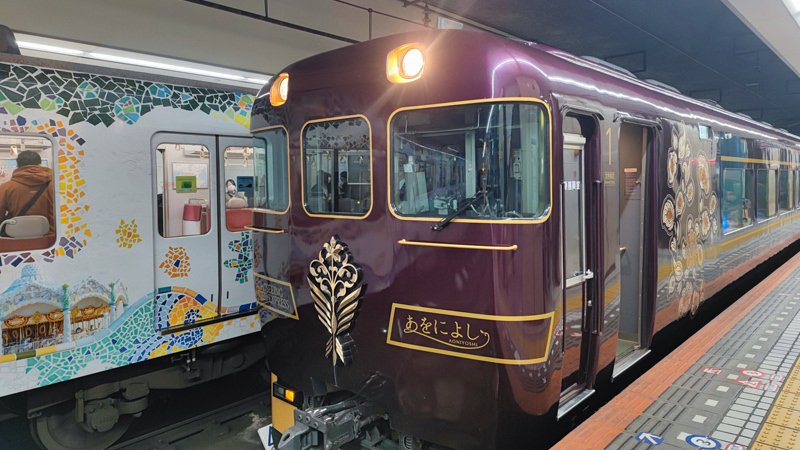 Getting Around Tokyo by Subway
Getting Around Tokyo By Subway (Metro & Toei)
- Best for: central Tokyo neighborhood discovery
Getting around Tokyo by subway can be one of the most convenient ways to explore the central city: with 13 lines and more than 280 stations, Tokyo's subway system forms a vast underground network that covers nearly every major sightseeing district, from business hubs to historic neighborhoods, with clear signs and well-paired English.
You're rarely more than a short walk (within 5 minutes) from the station to those popular sites. However, avoid travelling at rush hour from 7:30 to 9 am & 5 to 7:30 pm
Tokyo Subway Map
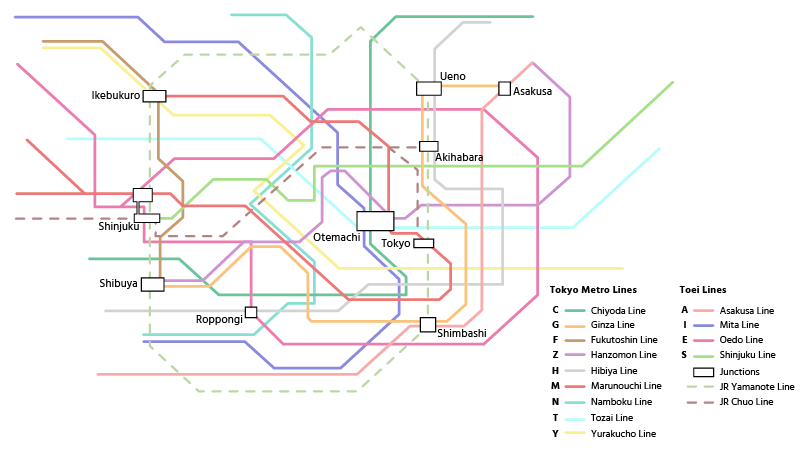 Tokyo Subway Map
At first glance, the overlapping routes and complex maps can feel overwhelming. A helpful trick is to follow the color coding and line letters used throughout the system.
For example, when heading to Asakusa Station (represented by A18 and G19) to see the popular Sensoji temple, you can take the Asakusa Line (A) and get off at station 18, or the Ginza Line (G) and get off at station 19. Or travel with Odynovo, leave all the lines and exits navigation to your professional private local guide.
Below are some popular stations in Tokyo subway lines for your quick check:
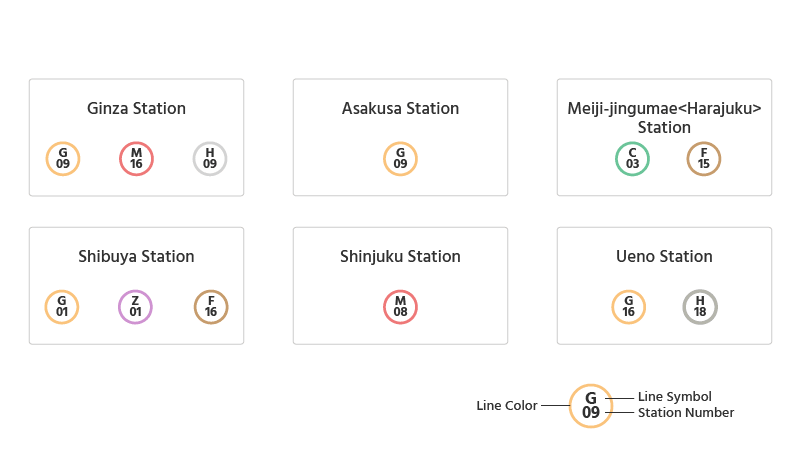 Popular Tokyo Subway Stations
Popular subway lines in Tokyo include:
- Ginza Line: well-connected Shibuya, Shimbashi, Ginza, Ueno, and Asakusa
- Marunouchi Line: the best one to take advantage of when starting from Tokyo or Shinjuku Station
- Hibiya Line: the more family-friendly one, direct to Akihabara and Ueno
Getting Around Tokyo By JR & Private Railways
- Best for: part of central Tokyo & reaching outer Tokyo
Compared with the dense subway network concentrated within the main neighborhoods, the railway network in central Tokyo is only a small part, anchored by the iconic Yamanote Line.
It is a circular route that links many of Tokyo's major city hubs, including Shinjuku, Shibuya, Shimbashi, Akihabara, Ueno, and Tokyo Station.
Though it may feel slightly less flexible than the intricate subway grid that cuts directly through neighborhoods, with frequent runs about every 3 to 4 minutes during the day, it is actually a smart and simple strategy for first-time visitors to get around central Tokyo.
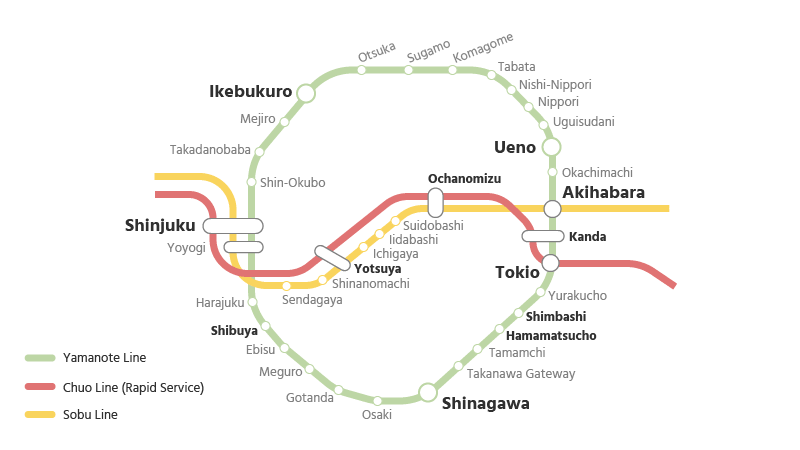 Tokyo Railway Map
Other popular railways in Tokyo that you can take advantage of:
- Shonan-Shinjuku Line: best for western Tokyo (Shibuya, Harajuku, Yoyogi, Shinjuku, and Ikebukuro)
- Keihin-Tohoku & Ueno-Tokyo Lines: ideal for the eastern part (Ueno, Akihabara, Tokyo Station, and Shimbashi)
- Chuo & Sobu Lines: the transfer line between the west (Shinjuku) and the east (Tokyo Station and Akihabara)
The JR and other private railway services are especially useful for reaching outer Tokyo districts and traveling beyond the city center (Narita Airport, Chiba, Yokohama, Hachioji, Atami), offering a better choice for day trips or intercity travel rather than short inner-city hops.
Transportation Pass to Get Around Tokyo
Suica Card: Most Flexible & Stress-free Option
Suica is always the top option. It is a prepaid IC card that works seamlessly across most subway and train stations, local buses, and select Shinkansen routes, and even many vending machines and convenience stores. It works across different rail operators, so you don't have to worry about which company runs which line.
Most importantly, a physical card is not necessary. Now, with a simple load up, you can have a Mobile Suica card directly in your Apple Wallet, and so do the online charges.
Tokyo Subway Ticket: Subway Only
The Tokyo Subway Ticket offers unlimited rides for a short period (1, 2, or 3 days) on Tokyo Metro and Toei Subway lines only. It does not cover JR lines, buses, private railways, or express trains, which can sometimes limit flexibility.
It is more economical for city sightseeing when you're spending two to three days in Tokyo and navigating multiple subway transfers along the way.
Japan Rail Pass: Better for Region Discovery Beyond Tokyo
The Japan Rail Pass is designed for travelers covering long distances across the country. It provides unlimited travel within a longer period (7, 14, 21 days) on JR-operated trains (including most Shinkansen bullet trains), local and express services, select JR buses, the JR Ferry, and the Tokyo Monorail.
The pass is most cost-effective for multi-city itineraries. For example, Tokyo - Kyoto - Osaka - Hiroshima - Osaka, rather than traveling confined to Tokyo alone.
Other Ways to Get Around Tokyo
Getting Around Tokyo by Bus
Buses are not typically recommended as a primary way to get around Tokyo. Compared with Tokyo's highly efficient train and subway network, city buses are generally slower, less frequent, and more complex to navigate, especially for first-time visitors.
Routes can be harder to interpret due to language limitations and fewer real-time English announcements, and accessibility varies by stop.
However, sightseeing or open-top buses (Sky Bus Tokyo, Sky Duck, Sky Hop Bus Tokyo) can be enjoyable alternatives, particularly for relaxed city views or nighttime skyline routes.
Getting Around Tokyo by Taxi
Taxis offer far greater privacy and door-to-door convenience, though taxi fares start relatively high in Japan. Take it as your emergency backup for late-night travel after trains stop around midnight.
More FAQs about Tokyo Transport
Which is better, subway or railway?
When deciding between the subway and railway in Tokyo, the key is not to commit to just one system. Tokyo's transportation network is designed to be interconnected, so the most efficient strategy is to use whichever line gets you there fastest, rather than worrying about the operator.
Subways (Tokyo Metro and Toei Subway) are excellent for dense, central areas, with stations close together and convenient access to neighborhoods like Ginza, Asakusa, and Roppongi. Railways, especially JR lines such as the Yamanote Line, are often faster for longer cross-city distances and major hubs like Shibuya, Shinjuku, and Ueno.
With a Suica or Pasmo card, transfers between subway and railway are effortless. In short, flexibility, not loyalty to one system, is the smartest way to get around Tokyo.
PS: If you are looking for a budget option, the subway is a relatively cheaper choice when using the pass ticket.
 Japan Railway
Is it necessary for a JR Pass?
For most visitors staying primarily in Tokyo, a Japan Rail Pass is not necessary. The JR pass is designed for long-distance, multi-city travel (e.g., the golden triangle route between Tokyo, Kyoto, Osaka, and Hiroshima in 10 days). Instead, prepaid IC cards (Suica or Pasmo) are usually more practical.
What is the difference between a Suica and a Pasmo card?
Functionally, there is no meaningful difference for tourists. Both are prepaid IC cards accepted on Tokyo Metro, Toei Subway, JR lines, buses, and even convenience stores.
The only distinction is the issuing company. Suica is issued by JR East, Pasmo by private railway operators. Officially, they are fully interoperable. Just choose whichever is easier to obtain.
How to deal with the balance in the Suica or Pasmo card?
You can recharge the card easily at ticket machines, convenience stores, or digitally (for mobile versions). Or, simply spend down the remaining balance at airport shops, vending machines, or convenience stores before departure, which can be easier than refunds for physical cards (minus a small handling fee).
How to find the right way in Shibuya or other stations?
Use Google Maps or official railway apps (Navitime, Tokyo Metro) for platform numbers and exits. Follow line colors and numbers, not just station names, and allow extra time when transferring at major hubs. Or simply contact us for your guided private Japan tour.
Are the Tokyo subway and trains open 24 hours?
No. Most trains and subways run roughly from 5:00 a.m. until around midnight. After the last train, options are limited to taxis or late-night buses (which are limited). Official timetables are reliable and punctual, so check the time of the last train in advance, especially after evening dining or nightlife.
Recommended Tours

Related Posts You May Like