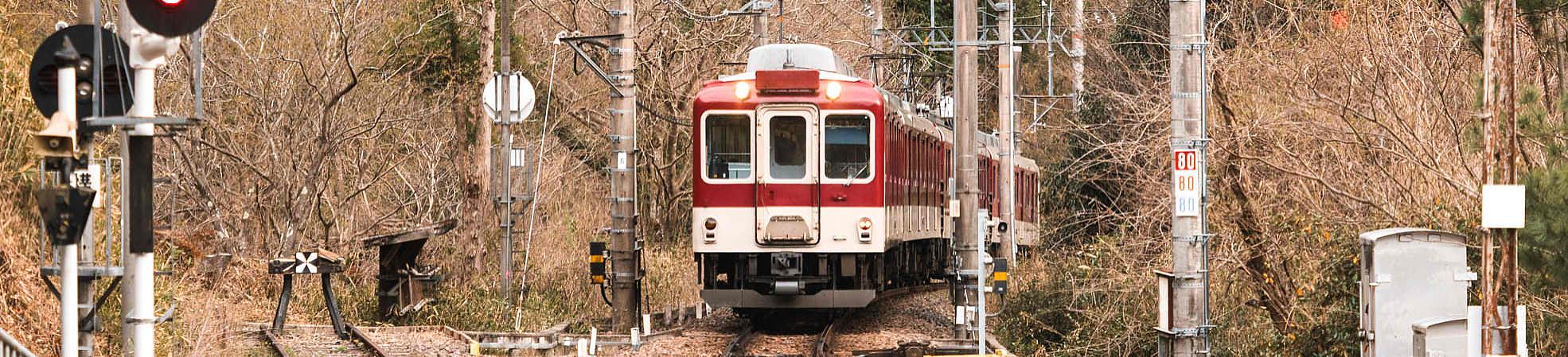
Guide to Take KTX, Korea Train Express 2026
The Korea Train Express (KTX) is one of the fastest and most convenient ways to travel around South Korea. Reaching speeds of up to 305 km/h (190 mph), the clean, punctual, and visitor-friendly high-speed train links Seoul with most major cities in under three hours. Below is your ultimate KTX train guide to take advantage of this bullet train to make the most of your trip to South Korea.
What is KTX (Korea Train Express)
The Korea Train Express (KTX) is South Korea's high-speed rail network operated by Korail. Since its debut in 2004, it has connected the country's key regions with impressive speed and comfort: you can cover almost the entire country in hours, making it the easiest, most time-efficient way to experience South Korea's differences and authenticity.
- Top speed: 305 km/h (190 mph)
- Main lines: Seoul ⇄ Busan, Seoul ⇄ Gangneung, Seoul ⇄ Mokpo
- Average travel time: Seoul to Busan (from northern to southern Korea) in just 2.5 hours (versus 4+ hours by car)
Korea Train Express Route Map
The KTX network stretches from Seoul in the north to Busan in the south, with branches to Gwangju, Yeosu, Pohang, Gangneung, and Mokpo. It connects most major tourist destinations across the peninsula.
Below is a simplified reference Korea Train Express route map:
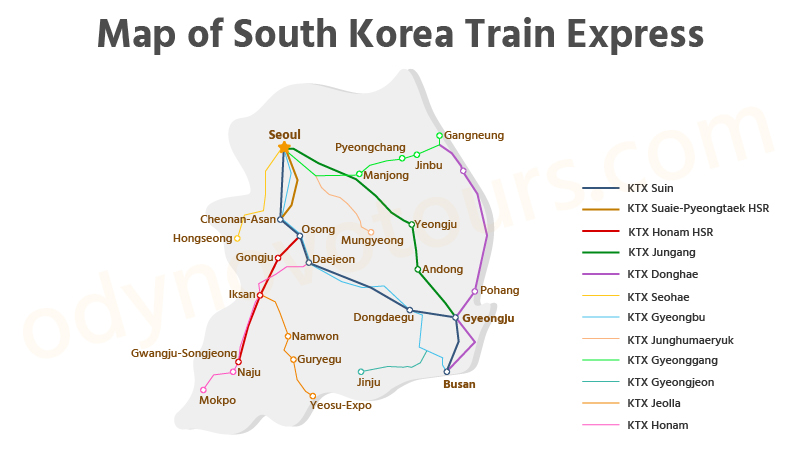 Map of South Korea Train Express
Popular KTX Day Trips from Seoul
| Destination | Travel Time | Things to Do |
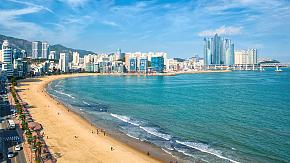
| Busan | 2.5 to 3 h | Beaches, Jagalchi Market, Gamcheon Village |
| Gyeongju | 2.5 h | Ancient temples & royal tombs |
| Daegu | 1.5h | Modern shopping & local food |
| Daejeon | 1 h | Science museums, hot springs |
| Gangneung | 2 h | East coast beaches, coffee street |
Korean Train Tickets Booking
You can book tickets through the official Korail website (available in English), the Korail mobile app (not that easy to use, actually), and station ticket counters or vending machines.
Note:
- Major Visa or MasterCard are accepted, though some foreign cards may fail (It's not you, it's the Korail payment gateway).
- Online booking opens one month in advance, yet still a risk of quickly selling out during weekends, holidays, and cherry blossom season.
- After the online payment, you'll receive a confirmation email with your ticket. Print it out before boarding your train, or show the QR code on the Korail mobile app at the gate.
Sounds like a lot of clicking and refreshing? You're not wrong. For stress-free travel, you can simply book your KTX tickets through Odynovo as part of your custom private South Korea itinerary.
We'll secure your preferred seats in advance, handle all payment and documentation, coordinate transfers, luggage, and local guides for each stop. That means you skip the language barriers, the payment errors, and the 11th-hour ticket panic. Just simply enjoy your ride.
Is the Korail Pass Necessary
The Korail Pass is a special unlimited-ride rail pass for international tourists. Think of it like Japan's JR Pass for Shinkansen and more, but smaller in scale.
Pass types include 2, 3, 4, or 5 consecutive days, or flexible options within 10 days. It is best for travelers planning multiple long KTX journeys, like the round trip from Seoul to Busan, Gyeongju. However, if you're only taking one or two single trips, buying regular tickets will be more helpful.
How to Take the KTX, Korea Train Express
Arrive Early, Give Yourself 20 to 30 Minutes
KTX stations are large, clean, and well-signed in English, but it's still best to arrive at least 20 to 30 minutes before departure, since you will need some time to print or confirm your ticket if needed, pass through light security checks, and find the right platform. Also, most KTX trains will open boarding around 15 minutes early - an ideal period to secure some space for your huge luggage.
If you're connecting from the subway, factor in a 10-minute walk inside Seoul or Busan Station since these stations are big!
Find Your Platform & Carriage
Look for large digital boards overhead showing platform numbers. Clear car number signs on the floor and pillars can also be seen on each platform. Car 1 usually starts at the front (moving forward); car numbers increase toward the rear, so follow the markings on the platform to stop near your car.
Boarding & Store Your Luggage
Large suitcases go on luggage racks near the doors or at the end of each carriage, while smaller bags fit easily in overhead shelves. Keep valuables (passport, wallet) with you.
Now Have a Seat
Find your place where seats and rows are clearly labeled. Place your ticket or phone nearby, as conductors occasionally scan tickets in motion, though not always. Announcements are bilingual (Korean and English), and Wi-Fi is available on most routes, so you'll always know which stop is next.
Getting off the Train
As you approach your stop, check the screen above the aisle for your station name. Trains stop briefly, usually just 2 to 3 minutes, so have your luggage ready near the door. There's no need to scan out, once off, follow the Exit (출구) signs to the main concourse or connections.
More Tips for Riding KTX
- Doors close 1 to 2 minutes before departure, and trains leave exactly on time, no waiting for late passengers.
- Pack Smart. There's no checked baggage service on KTX, so bring what you can comfortably lift. If you're carrying large suitcases between cities, consider door-to-door luggage delivery (available in Seoul, Busan, and Jeju), or contact us and let Odynovo arrange transfers as part of your customized trip while you ride light.
- Quiet is golden. Most Koreans keep themselves on trains, no loud phone calls, music, or speaker videos. Some cars are labeled "Quiet Cars". Use headphones for entertainment and text instead of talking if traveling with family and friends.
- Light snacks are fine; full meals or strong smells are frowned upon.
- Don't recline your seat suddenly, always glance back before adjusting.
- When booking online, you can usually pick your ideal seat. Window seats offer views and a power outlet, and aisle seats make it easier to get up and stretch.
- Missed your train? Don't panic. You can exchange your ticket at the counter for the next available train (a small fee may apply). Or skip the stress entirely by booking your custom Korea trip with us! We'll manage all transfers, tickets, and schedules, so you can just sit back, enjoy your coffee, and watch the countryside roll till your next South Korean trip destination.
More Facts about KTX
Why Take KTX
- Faster than flying: When you add airport check-in, boarding, and transfers, KTX often gets you there sooner than a domestic flight (and less turbulence, too).
- City center to city center: No long rides from airports. You board in downtown Seoul and step off right in the heart of Busan, Gyeongju, or Gangneung.
- Comfort without the premium price: Even the standard class feels close to a short-haul business flight, but at a fraction of the cost.
- Smooth, quiet, and scenic: Large windows reveal a moving panorama of Korea, from rice fields and coastal towns to mountain ranges, and all while you relax in an air-conditioned cabin.
- Punctuality you can count on: KTX trains depart on time, down to the minute; delays are almost unheard of.
- Eco-friendly travel choice: Korean Train Express emits far less CO₂ than planes or cars.
- Train to Busan: The KTX train from Seoul to Busan is the main setting of this popular zombie movie.
Types of KTX Trains
KTX (Original Model): The classic high-speed train that first launched in 2004. It's sleek, powerful, and ideal for long intercity routes, like Seoul to Busan. Seats tend to be slightly more spacious than Sancheon, with smoother acceleration, which is great if you're traveling with family or luggage.
KTX-Sancheon: Introduced later in 2010, the Sancheon (meaning "mountain stream") is a newer, high-tech, quieter, locally designed model. Often used on routes like Seoul to Gangneung or shorter legs to the southern coast, best for travelers who like modern interiors and digital conveniences.
KTX Seat Classes
First Class, Comfort Meets Calm
If you're the kind of traveler who values a bit of space, quiet, and that "just relax and watch the scenery" mood, First Class is a treat.
You'll get wider leather seats arranged 2+1 per row, with generous legroom and deep recline; seat-side power outlets, footrests, and coat hooks; complimentary bottled water and a calm, business-travel vibe.
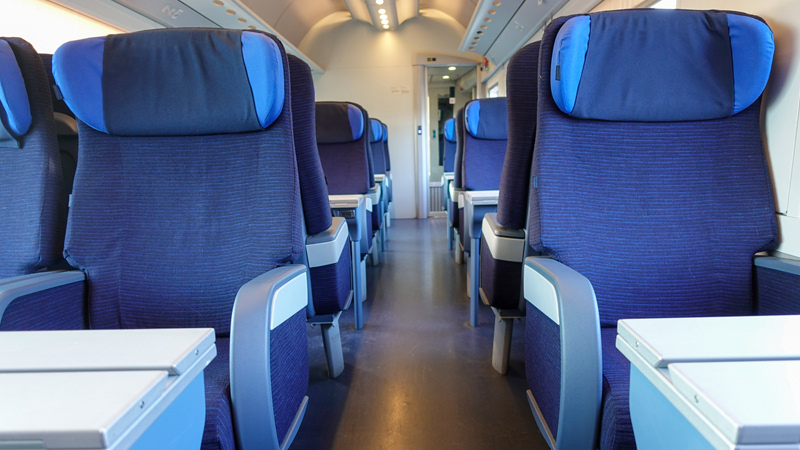 First Class Seats
Standard Class, Smart, Simple, & Still Very Comfortable
The most common book, and honestly, it's already pretty great. Seats in standard class are arranged 2+2 per row with enough legroom for tall passengers. You'll find foldable tray tables, luggage space above your seat, vending machines, as well as power outlets and free WiFi.
Also, many seasoned travelers say they don't feel a big difference between first and standard unless it's a peak holiday weekend. So if you're budget-conscious, standard class is excellent value.
Note: Both classes have quiet zones and bilingual digital screens showing your route, stops, and ETA. Just relax, even on your first KTX ride.
Other Korean Train Types
If your route isn't covered by KTX, Korail offers other great options:
- ITX (Intercity Express): Slower than KTX, but still fast and modern, often used for medium distances like Seoul to Chuncheon.
- Mugunghwa: Older, budget-friendly trains with scenic countryside views, good for slower, more relaxed journeys.
Recommended Tours
-

Autumn Colors Tour in South Korea 2026
10 DaysSeoul, Nami Island, Sokcho, Naejangsan, Jeonju, Busan -


Related Posts You May Like