10 Interesting Facts About Jordan's Wadi Rum
When you travel through southern Jordan, you'll eventually reach a breathtaking desert of red sands and towering sandstone mountains: Wadi Rum, also called the "Valley of the Moon." You've probably seen its dramatic scenery in movies, but there's much more to this vast wilderness than meets the eye. Here are 10 interesting facts to know before taking your trip to Jordan to explore Wadi Rum.
1. It Is Almost As Large As New York City
Wadi Rum lies in the far south of Jordan, and east of the Rift Valley. It is a large area, about 60km (35 mi) northeast of Aqaba, 100km (60 mi) south of Petra, and 300km (185 mi) south of Amman.
It was officially protected as the Wadi Rum Protected Area in 1997 and now covers an area of 74,200 hectares (about 183,352 acres), nearly as large as New York City.
2. It Is Mars on Earth
The blood-red sands and the unworldly sandstone mountains create an uncanny Mars-like landscape and environment, making you truly feel like you are stepping foot on another planet, though you are right here on Earth.
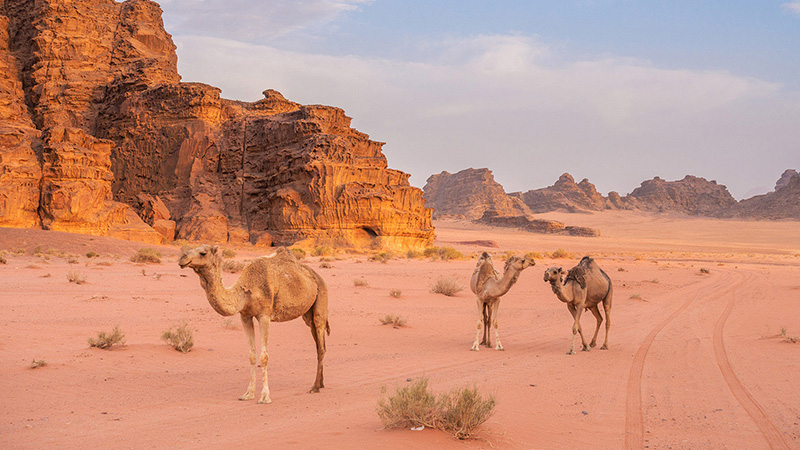 Camels in Wadi Rum
3. It Is A Favorite Hollywood Film Set
With its reddish sands and rugged mountains resembling the arid surface of Mars, Wadi Rum has become a Hollywood favorite for movies set on the Red Planet. It has served as the backdrop for major films such as The Martian (2015), The Last Days on Mars (2013), Red Planet (2000), and Mission to Mars (2000).
Beyond its Martian landscapes, Wadi Rum has also appeared in other blockbusters like Dune: Part Two (2024), Star Wars: The Rise of Skywalker (2019), Prometheus (2012), Transformers: Revenge of the Fallen (2009), and the classic Lawrence of Arabia (1962).
4. It Has Many Arches
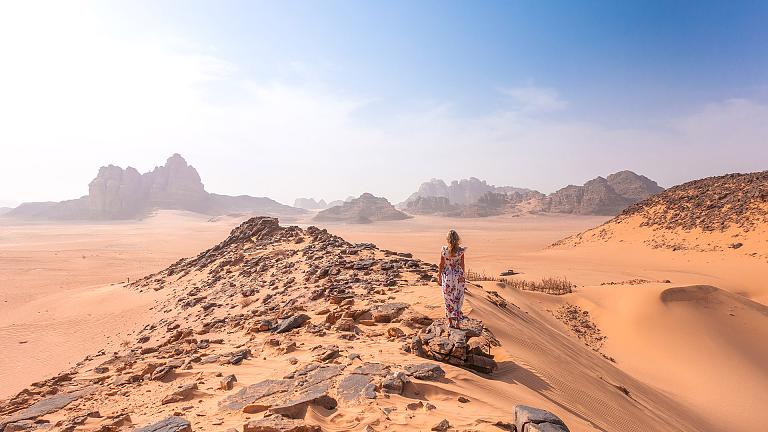
One of Wadi Rum's most striking features is its collection of natural rock arches, formed over millions of years by wind and erosion. Some rise dramatically above the desert floor, offering panoramic views for adventurous climbers, while others hide quietly among the sandstone cliffs.
Famous ones like Burdah Rock Bridge, Um Fruth Rock Bridge, and Little Bridge are must-sees for visitors. The largest of these three arches, the Burdah Rock Bridge, is impressively 80 meters high.
Recommended Tour Itinerary
5. It Is A Big Open-Air Library
Besides stunning desert landscape, Wadi Rum also boasts astounding cultural landscape. 25,000 petroglyphs (rock carvings), 20,000 inscriptions, and 154 archaeological sites have been discovered within this place, tracing the evolution of human thought and the early development of the alphabet.
The petroglyphs, mostly engraved on rocks, boulders and cliff faces, span all eras from the Neolithic to the Nabataean. They represent figures of human holding bows and arrows, and animals like camel, ibex and horse, as well as symbols like lines and circles, offering a rare window into the long-term patterns of pastoral, agricultural and urban human activities here. These petroglyphs also reveal climate change from mildly humid to the current arid desert.
The numerous inscriptions are mainly in four different scripts, Thamudic, Nabataean, Islamic and Arabic, testify to the widespread literacy among the societies in this Arabian Peninsula.
6. It Was An Early Human Habitat
Widespread petroglyphs, inscriptions and archaeological remains illustrate that many humans of different cultures inhabited Wadi Rum as early as 12,000 years ago since prehistoric times and interacted with the natural environment there.
One of its famous inhabitants is the Thamud people living here from at least the 8th century BC, which was a nomadic tribe related to the mysterious Nabateans (builders of Petra) and referred to as Arabs in the Quran.
Currently, its inhabitants are mainly Bedouin, about several hundred of them live in their goat-hair tents and concrete houses in the Rum village. The word bedouin comes from the Arabic badawī, meaning "desert dweller".
7. It Is Adventurer's Paradise
Here you have many chances to take genuine desert adventures. Take a four wheel drive deep into the vast desert, go on a camel safari to explore the rugged landscape, you can easily experience the grandeur that Wadi Rum has to offer.
You can even soar over Wadi Rum on a hot-air balloon or a light aircraft to admire the wonderland dotted with thousands of dramatic rock formations and other spectacular landscapes in a new way.
For eco-adventure, rock climbing on the sandstone mountains, sandboarding down the sand dunes and hiking around the valley are good choices.
Recommended Tour Itinerary
8. It Is A Feast of Colors at Sunset
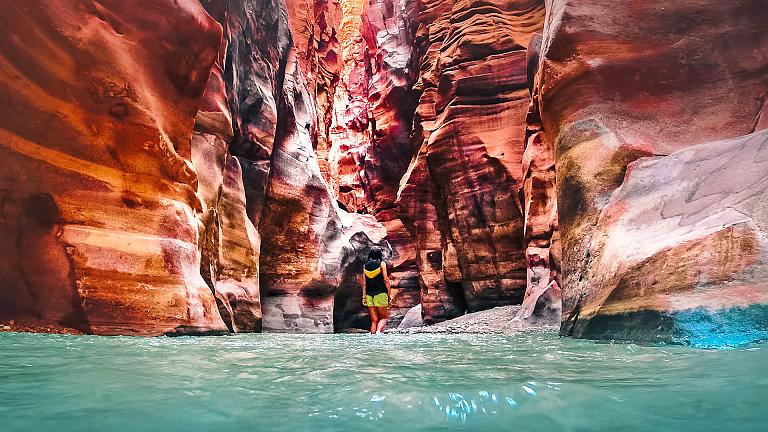
One of the best moments of a day in Wadi Rum is sitting on a rock and waiting for the breathtaking sunset. As the sun set over the rolling landscape, Wadi Rum lit up into different hues.
You will see the sky slowly changes from an azure blue to a soft blue, to a pale pink, to a brilliant orange, to a burning red, and then to a French grey and light black, and finally completely dark with bright stars shining in the sky. It's truly a feast of changing colors.
9. It Has Some Luxury Camps
Wadi Rum offers a chance to experience the desert's wild beauty without sacrificing comfort.
Scattered across the vast red sands are a number of luxury desert camps. Many feature dome-style tents or glass pods, offering 360-degree views of the starry sky, private bathrooms, and even air conditioning. You can enjoy traditional Bedouin dinners, relax by a campfire, and wake up to the golden sunrise over Mars-like landscapes.
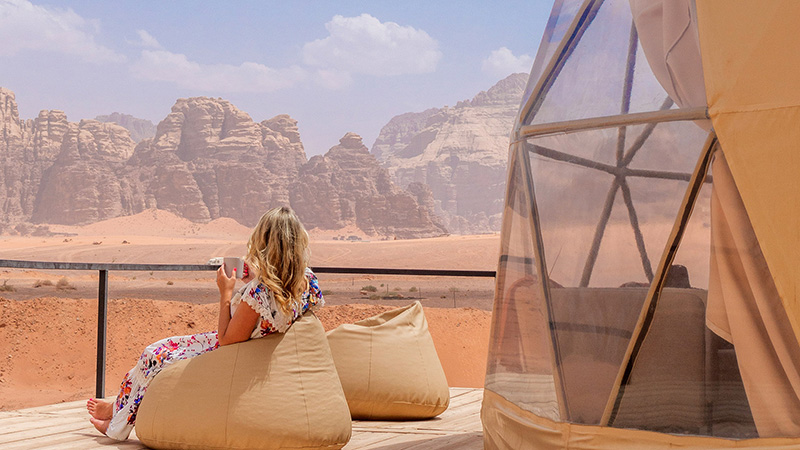 Camping in Wadi Rum, Jordan
10. It Is Good to Visit Except for Summer
Wadi Rum is not an ideal year-round destination. The best time to visit is from March to May and September to November, when temperatures are mild and the desert is most enjoyable for outdoor activities.
Spring is especially lovely. With wildflowers dotting the sand, you may spot baby goats and camels near Bedouin herds. From October to April, the weather is comfortable enough for hiking and climbing.
The day of winter (December to February) in Wadi Rum is also mild, usually about 10-18°C (50-64°F). While when the night falls, it may get freezing cold.
Avoid visiting Wadi Rum in summer (June to August), when daytime temperatures can soar above 40°C (104°F). During this period, any outdoor exploration is exhausting.
Plan Your Trip to Morocco With Odynovo
After knowing all these 10 interesting facts about Wadi Rum, will you plan a trip to this red wildness? Should you have any questions about Wadi Rum and trip planning to it, please feel free to contact us at [email protected] .
Recommended Jordan Tours
-

-
-
-
Explore Middle East: Egypt, Jordan and Israel14 DaysEgypt: Cairo, Nile Cruise, Luxor; Jordan: Amman, Jerash, Petra, Dead Sea; Israel: Jerusalem, Bethlehem, Tel AvivExplore This Tour